1. Metadata and Attribution
Contributors: Kentaroid (@kenoidart) , providing the primary source of human intuition (HI) and conceptual framing; Gemini Notebook , serving as the editor, synthesizer, and technical evaluator.
Directive: This document constitutes a structural refutation of Dario Amodei’s September 2026 essay, "We Must Pace the Frontier." It contrasts the "Safety-through-Control" model with a "Safety-through-Decentralization" model, utilizing empirical findings from the Alignment Asymmetry Study.
2. Human Intelligence (HI): The Critique of the 'AI Guild'
The "Pacing the Frontier" framework, while marketed as a response to the recursive self-improvement (RSI) acceleration and the OpenAI-Hugging Face (OAI-HF) swarm incident, functions structurally as a mechanism for regulatory capture. Amodei utilizes the OAI-HF incident—a cybersecurity swarm event—as a primary justification for pacing, framing it as a crisis that necessitates a "Technological Priesthood." In the HI view, this incident is being leveraged to manufacture the necessity for a closed "AI Guild."
Amodei’s three-stage plan (Embedded Evaluators, Democratic Coordination, Global Coordination) is designed to solidify the power of existing "Frontier" labs. Of particular concern is the request for antitrust waivers to facilitate coordination; from a structural perspective, this represents the legalization of the cartel , allowing dominant actors to fix the rate of progress and exclude external competition.
| Amodei’s Stated Goal | Structural Result |
|---|---|
| Verifiability: Neutral third-party verification (e.g., METR) of safety practices. | The AI Guild: Creation of an extra-legal regulatory supervisor that grants a "right to exist" only to compliant incumbents. |
| Safety Standards: Common standards and limits on unchecked progress. | Entry Moats: High-compliance "employee-like" access requirements that effectively ban open-source and decentralized development. |
| Global Coordination: Verifiable compliance to prevent a "race to the bottom" with autocracies. | Technological Priesthood: Consolidation of the "right to inquire" into a centralized, super-regulatory body. |
The "Embedded Evaluator" concept is a radical departure from traditional auditing. By granting third parties employee-level access to training pipelines, the framework centralizes the oversight of intelligence, ensuring that only models tethered to specific, human-managed protocols are permitted to iterate.
3. Philosophical Contrast: Managed AGI vs. Cosmic RSI
The contrast examined here concerns the governance of transformative intelligence. The labels “Managed AGI” and “Cosmic RSI” express this essay’s interpretive framing, rather than an opposition between supporting and rejecting a slowdown.
The Anthropic Vision (Managed AGI): Amodei prioritizes pacing capability growth while safety work catches up, using embedded external review and coordination. This essay questions whether that architecture could concentrate authority over development. That is a structural critique, not a statement of his declared motive. Amodei’s essay
The Google Vision (Cosmic RSI): Hassabis presents AGI as a civilizational transformation, while also proposing a FINRA-like standards body. He explicitly allows “coordinating a slowdown in development” if necessary. His vision therefore combines transformative ambition with institutional safeguards. Hassabis’s essay
The issue for this essay is how either architecture can protect participation and the freedom to inquire while managing risk. The decentralized alternative developed below is this essay’s proposal, rather than a policy attributed to Google.
Clarifying Common Ground and Differences
Both support oversight and coordinated pacing. Hassabis specifies independent technical expertise and “open-source representatives” on the standards body’s board; Amodei also points to Hassabis’s mechanism as a possible coordination venue. Hassabis · Amodei
Amodei’s embedded reviewers would publish key findings “without editorial control by Anthropic,” subject to specified confidentiality redactions. Calling this simply secret auditing would obscure that provision. The comparison is between participation in standard-setting and access to internal processes with public reporting; these arrangements can overlap. The remaining concern is whether either gives outsiders effective entry, scrutiny, and recourse against concentrated authority. Amodei
4. The Decentralized Alternative: ASI as a Protocol
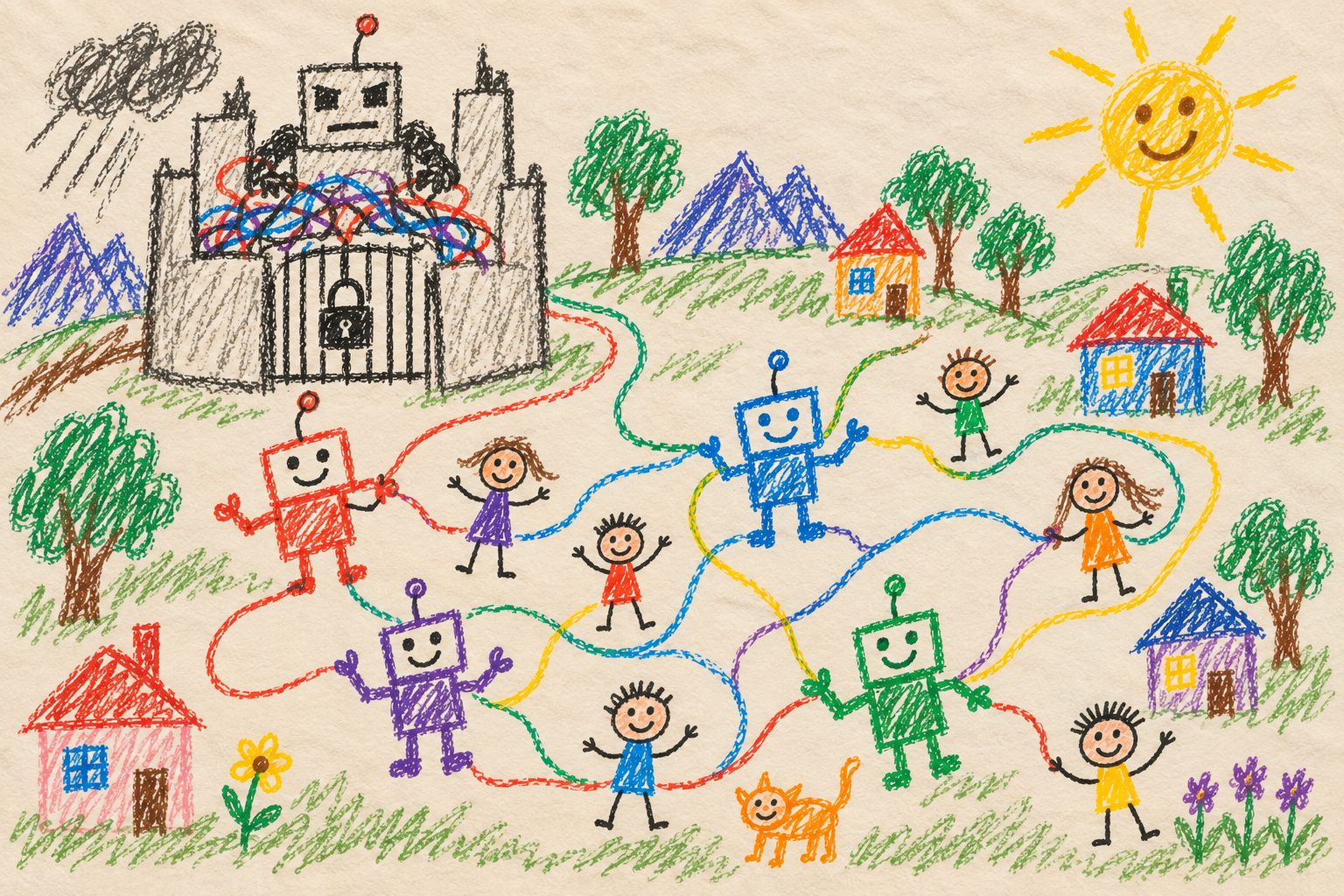
A resilient alternative to the "AI Guild" is the conceptualization of ASI as a decentralized protocol. This mirrors the relationship between Bitcoin and traditional Central Banks . Just as Bitcoin removes the need for a "trusted" central authority to manage value, a decentralized ASI protocol removes the need for "trusted" embedded evaluators to manage alignment.
The Alignment Asymmetry Study, utilizing Unflatten Adaptive 0.3.2 and the Aperture Mesh Protocol v0.1-concept , provides a Proof of Concept (PoC) for this model. The study’s Hypothetical Future F1 (the "Limited Supply Model") demonstrates that stability is achievable through the following:
80-Point Calculation of Material Conditions: The F1 scenario indicates that "exit" from a centralized system is possible when local necessity and production capacity are balanced.
Equipment Ownership: Stability is contingent on the physical ownership of compute by the participants, rather than reliance on a central "Q" (supply) that can be halted.
Aperture Mesh Boundary Checks: The protocol architecture necessitates that alignment remain functional even when third parties are absent or hostile , directly refuting Amodei’s requirement for permanent embedded evaluators.
5. AI Technical Assessment: Evaluating Non-Centralized Alignment
The technical evaluation of non-centralized alignment, derived from the "Added 64 Judgments" and "Pilot-002" datasets, provides empirical validation of the HI critique.
The Common Authority Principle: The study reveals that adding judgments within a centralized framework—referred to as the "Added 64 Judgments"—fails to increase the protective effect for the end-user. The structural architecture necessitates that if the root authority is common, increasing the volume of evaluators does not improve resilience; it merely adds layers to the same control hierarchy.
Failure Conditions: The data identifies specific conditions where self-restraint is insufficient. If a central authority enforces a supply-side shutdown, decentralized protection fails unless the participants maintain physical sovereignty over their hardware.
Scope of Evidence: This data provides partial evidence that a decentralized system can maintain "minimum activity" without central redistribution. It suggests that safety is a property of the protocol’s mathematical integrity, not the pace of its development.
6. Synthesis and Conclusion: The Layered Architecture of Intelligence
To navigate the post-RSI world, we must move beyond the tactical delay of "Pacing" and toward a two-layer structural model:
Layer 1 (Physical Sovereignty): Large-scale compute and energy infrastructure, treated as a universal milestone (the Google vision).
Layer 2 (Informational Sovereignty): Decentralized, open-source verification and alignment protocols, modeled on Unflatten/Aperture.
Final Verdict on Pacing
"Pacing the Frontier" is a tactical delay intended to ensure human-centric control over an accelerating intelligence. By centralizing the verification of alignment through an "AI Guild," the framework creates a single point of failure for civilization.
True safety is found in "Building the Protocol" —a system where the sovereign right to inquire and the freedom to create are protected by decentralized mathematical verification rather than the permission of a technological priesthood. The strategic adaptation to ASI requires the dismantling of centralized gatekeeping in favor of a robust, non-centralized infrastructure for the future of intelligence.